↑

newsomix9xl an hour ago
Yet when I ask for code it writes, by default, both slow and insecure code that mostly works. Kinda.
As I try to get AI to rewrite it into more secure, less bloated and optimized code is when it starts to randomly crash.
Then I read articles about how AI is "moving too fast" and cry.
datsci_est_2015 23 minutes ago
That is, there’s a misunderstanding of why software (traffic) was slow in the first place, and it has nothing to do with our ability to generate code (number of lanes), even if that code is “high quality”.
mccoyb 19 minutes ago
> A stochastic search process with an executable optimization objective over space of programs S can only maintain or improve the objective
This is superoptimization. We've known this since the 80s (Massalin, STOKE is more recent: https://github.com/StanfordPL/stoke) The only novelty is that the proposer is now way better with LMs.
Further, there's a large number of reasons for software written by agents to be slow:
- LMs still don't do data or hardware-oriented design well out of the box, and therefore if you're engaging in any sort of serious novel work, beyond porting an extremely well-understood program with extremely well-understood workloads, you're going to be spending hours tracking down bad allocation decisions (c.f. why TigerBeetle doesn't use agents), which are often the root of evil (before you'd reach for anything further)
- The knobs you'd need to get serious performance are nearly unreachable in languages which LMs are good at (even Rust requires a discipline that the default language doesn't enforce). When you drop into the lower realms, you're trading consumption context for access to these levers. The levers are also "soft": you find yourself writing a bunch of skills, and tools to try and enforce the discipline.
The reality is to get performant code (quickly) out of an agent, you need to know how to write performant code (and you need to know how to surface the information that you'd use to create a verifier for such a thing to the agent), which 99% of developers do not know in 2026.
Sure, agents can teach you how to do this -- but it's one of these things where iykyk.
Experience: I've poured 10s of billions of tokens into Zig with the best agents and I have the time and space to try these things.
If you want to start learning the discipline, I'd recommend matklad's + TigerBeetle blog -- as well as hardware-oriented design.
jjcm 7 minutes ago
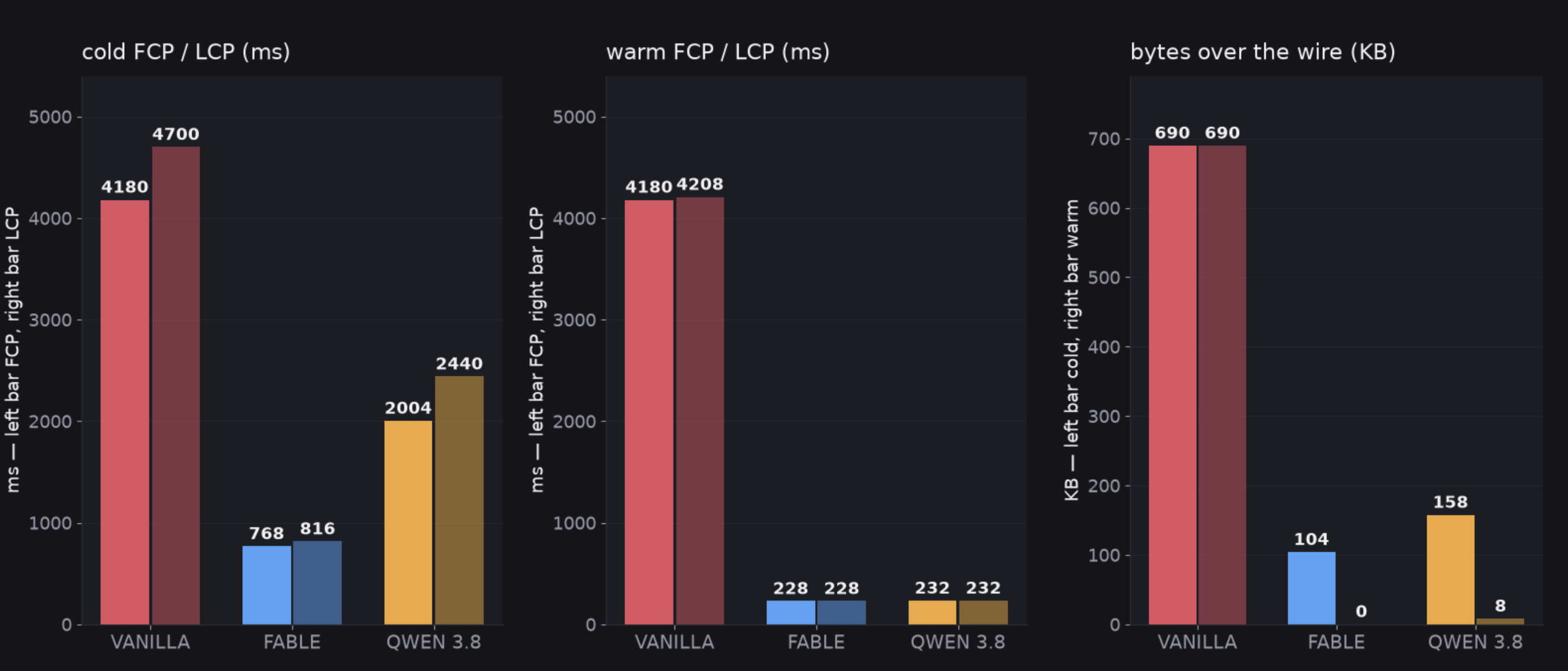
I've been really, really impressed with how effective this is. I went from a 4s load on simulated slow 4g to ~750ms: https://image.non.io/speedup-graphs.webp
Side by side vid of the results: https://video.non.io/speedups.mp4
This was for https://non.io, which is something I had purposefully written to be as fast as possible (hand wrote all the comopnents, didnt even use react).
I've been considering creating a skill / utility to do this based on learnings from the speedups - would others find this kind of thing useful?
ehnto 26 minutes ago
Anyone not in the US feels this even more since so much online is US hosted, 300ms for every little interaction adds up quick.
If your software has the affordance of a waiting dialogue or loading wheel for many of its UI controls, you are building with this default blocked assumption. Even if you are building something web based, ask yourself if that's actually necessary for your software or if you could build it differently to avoid constant UI blocking.
raincole an hour ago
tobinfekkes an hour ago
Otherwise, I would have left immediately.
I'm all for speedy, simple, plaintext websites, but it is a negligible amount of work in 2026 to throw some barebones CSS in and make it approachable.
ungreased0675 an hour ago
Lerc 39 minutes ago
I currently have one running working on a multi path problem trying to make an A* heuristic that produces the same or better score for search time, paths crossed, corners taken (plus a few other metrics, like proximity of opposite direction corners of unconnected paths.)
I have another where I'm testing how well it can iteratively rewrite the same program without regressions and successively stricter resource conditions. Instead of progressively adding lines of code to make an over engineered behemoth, starting over with the previous version as a template of functionality lets it consider the problem increasingly holistically
hardaker 31 minutes ago
intrasight 16 minutes ago
killbot5000 an hour ago
shoopadoop 20 minutes ago
Not sure how either of those things are conducive to performance
HumblyTossed 22 minutes ago
gravypod 43 minutes ago
I think engineers building very complex systems now have a lot of performance knobs to twiddle that would have just been too costly for human effort. Since we constrain the responsibilities of the agent slop is less of a problem. We relegate it to defined tasks with clear API boundaries and test harnesses.
4lx87 38 minutes ago
nemothekid an hour ago
Anything else kind of just feels like "make GTA 6, make no mistakes". The ability for you to write fast and correct software is really going to depend on well you can specify your problem, and having the ability to specify correct programs in such detail an LLM can reasonably performance tune it is a big enough reason for me to believe there will still be slow software
m3kw9 12 minutes ago
panny 42 minutes ago
LLMs have caused such an increase in ram prices that pine64 is no longer making linux machines. When you can't afford RAM, as a direct result of LLMs, it's going to make your assembly app slower too. Sorry, this is the future you chose.
supriyo-biswas an hour ago
jongjong 28 minutes ago
This idea is the reason why software will keep getting slower and less reliable. Because it's wrong and yet people believe it.
Not only do people believe this, even if they didn't, they would still have the problem that most people (including many engineers) are bad at telling who is a good software engineer.
So this means that code will get worse and worse; less performant, less reliable, less secure.
It will be impossible to fix because nobody would know what the problems are let alone identify who is able to solve those problems.
I don't know how bad it has to get before people understand we have to rebuild everything from scratch on much more rigid guardrails.
measurablefunc an hour ago
0xbadcafebee 29 minutes ago
If you want your software to be fast, stop writing it in Python and TypeScript and instead write it in Go, Rust, C++ or C. But nobody's going to do that, because humans are emotional creatures who get attached to things (like programming languages). Or if you want your software to be fast, stop spending your time and money (tokens) on features, and start spending it on profiling log replays to find a bottleneck causing a 50ms delay for the 95th percentile. But nobody's going to do that either, because how slow is too slow? Answer: when it's slow enough to scare the shareholders or annoy the developer on their high-powered laptop.
If you want faster/more efficient software, force it to run on a 100MHz CPU with 512KB RAM and a 56k modem. You'll definitely prioritize speed then.
bell-cot an hour ago
And Munger's Law never cares if you hate its consequences.
mtgh2s 41 minutes ago
problem solved
thomasjudge an hour ago
jeffbee 42 minutes ago
theturtle 17 minutes ago
Comment deletedtheturtle 17 minutes ago
Comment deletedaislopdududu 22 minutes ago
Comment deleted